






What is BlazeFL?#
BlazeFL is a lightweight framework for single-node Federated Learning (FL) simulation that eliminates the trade-off between throughput and reproducibility. By leveraging Python’s free-threading architecture, BlazeFL allows for shared-memory execution that bypasses the heavy overhead of inter-process communication (IPC) and serialization.
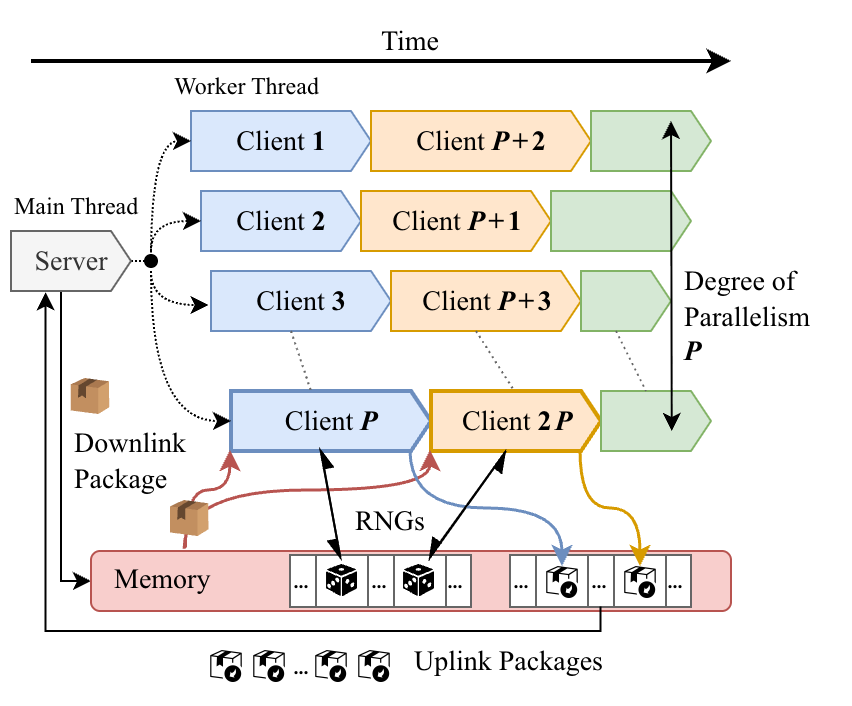
Architecture overview: Shared-memory execution eliminates serialization/IPC overhead. Isolated RNG streams ensure deterministic results.#
Feature Highlights#
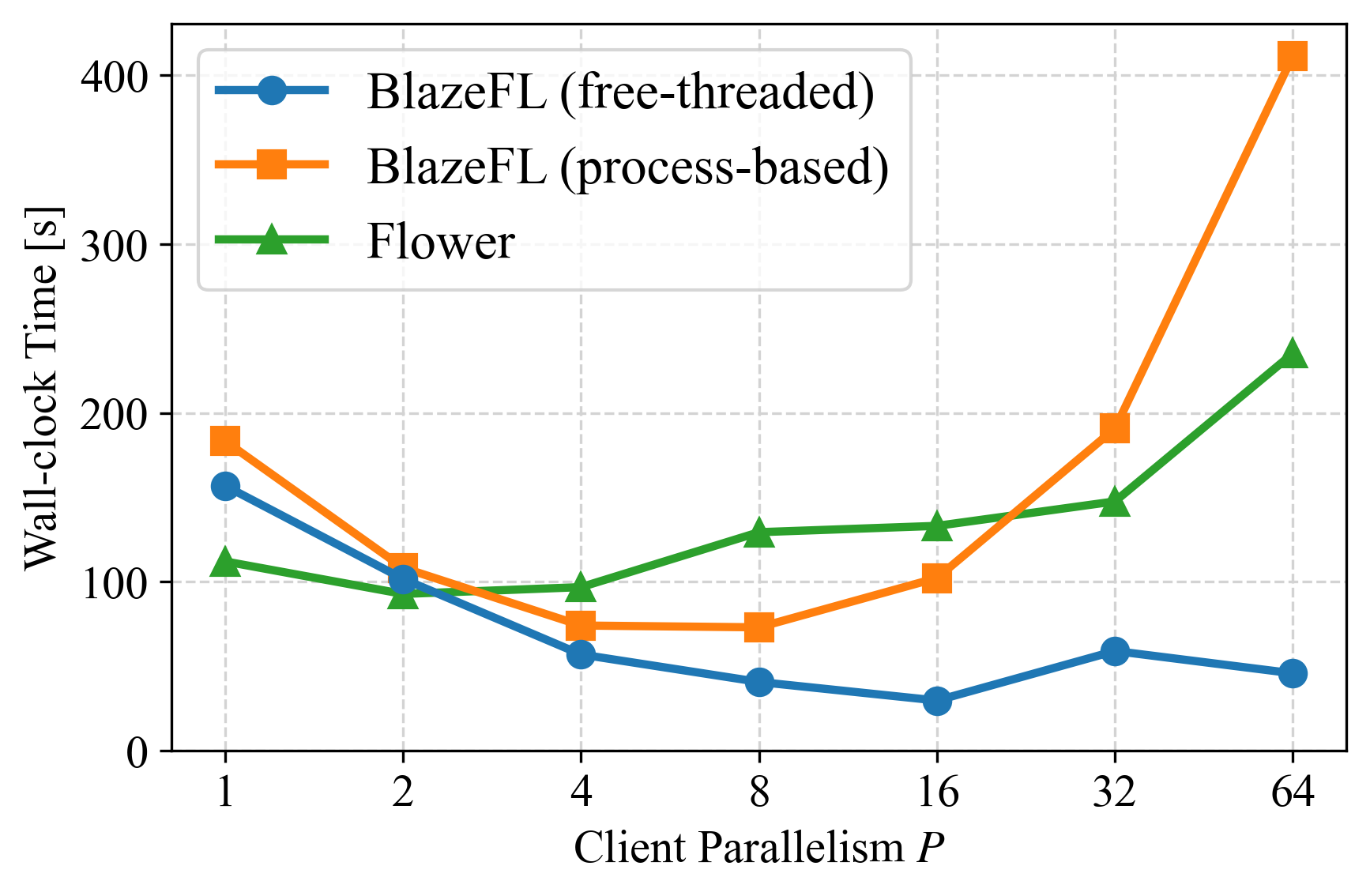
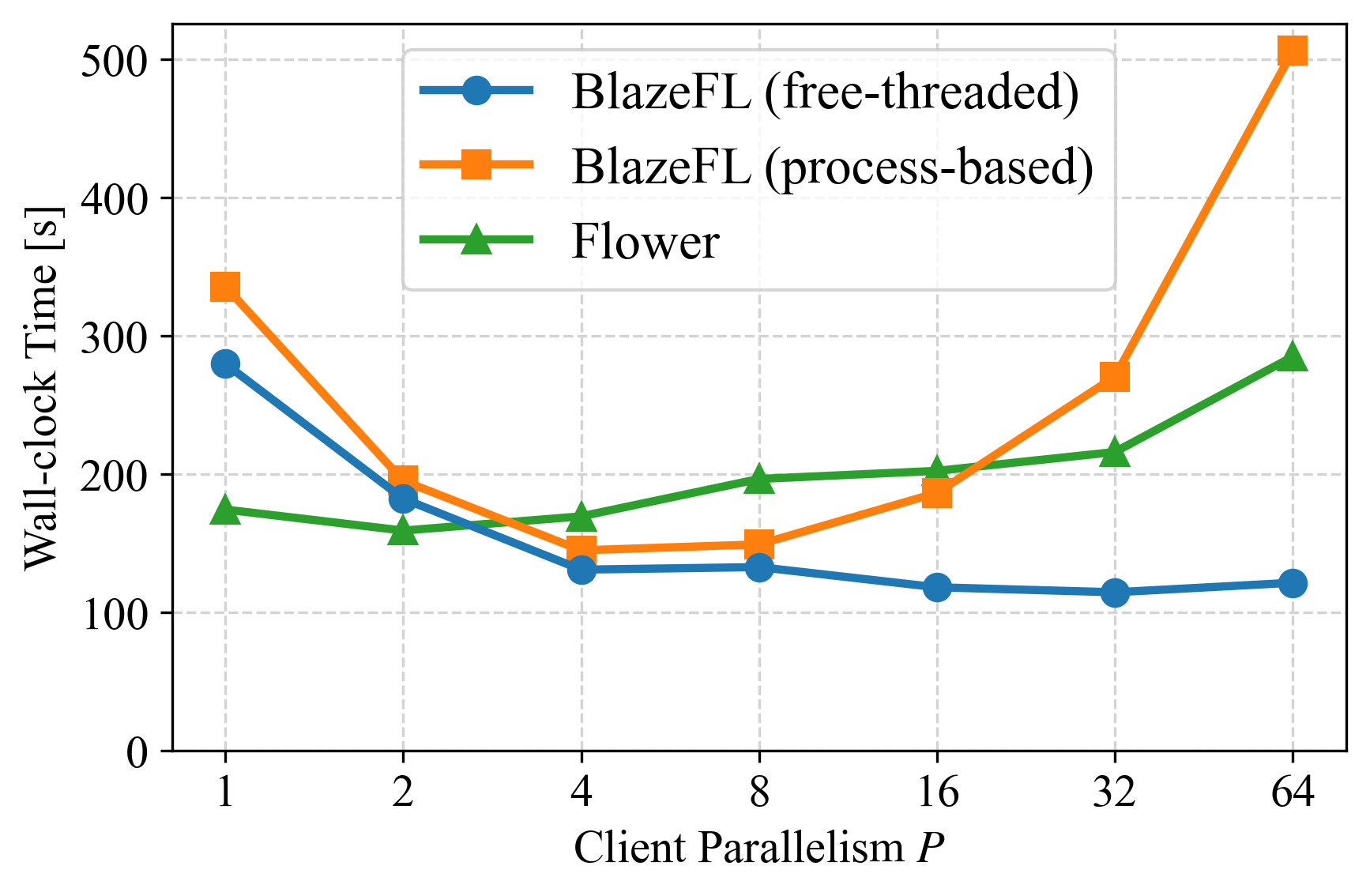
🚀 Zero-Copy Parallelism: Uses thread-based parallelism (PEP 703) to exchange model parameters via shared memory. Achieve up to 3.1x speedup on communication-heavy workloads compared to traditional process-based frameworks.
🔄 Bitwise Reproducibility: Guarantees identical results across runs, even with high concurrency. By assigning isolated RNG streams to each client, BlazeFL eliminates non-determinism caused by worker scheduling or completion-order-dependent aggregation.
🧩 No Framework Lock-in: Built on Python
Protocols. Integrate your existing PyTorch models and training loops with minimal changes. No rigid inheritance required.🍃 Minimalist Stack: Core execution relies only on PyTorch and Python standard libraries. Lightweight, easy to package, and highly portable.
Quick Look#
BlazeFL keeps the simulation loop explicit and easy to debug. Here is the core pattern:
# Server-Client interaction is straightforward
while not handler.is_stopped():
    # 1. Server: Sample clients and prepare downlink
    sampled_clients = handler.sample_clients()
    broadcast = handler.downlink_package()

    # 2. Client Trainer: Process clients in parallel (Threads/Processes)
    trainer.local_process(broadcast, sampled_clients)
    uploads = trainer.uplink_package()

    # 3. Server: Aggregate uploads
    for pack in uploads:
        handler.load(pack)
Execution Modes#
BlazeFL offers three execution modes to suit your environment:
Multi-Threaded (Recommended): Best for Python 3.14+ (Free-threading). Zero-copy sharing and minimal overhead.
Multi-Process: Utilizes separate processes to achieve isolation. Uses shared-memory tensors for efficient parameter exchange.
Single-Threaded: Simple, sequential execution. Perfect for debugging and initial prototyping.
Robust Reproducibility#
Parallel execution often breaks reproducibility due to floating-point rounding differences and global random state interference. BlazeFL solves this with a Generator-Based Strategy:
Each client is assigned a dedicated RNGSuite.
Random operations (sampling, shuffling, augmentation) consume these client-isolated generators.
Results are materialized in a deterministic order, ensuring bitwise-identical aggregation.
Tip
To ensure full determinism in vision pipelines, use transforms that accept explicit generators. BlazeFL provides utilities to snapshot and restore these states seamlessly.
Benchmarks#
In image classification experiments (CIFAR-10), BlazeFL substantially reduces execution time relative to widely used frameworks. The performance advantage is most pronounced in workloads where parameter exchange is the primary bottleneck.
|
|
Citation#
@misc{azuma2026blazeflfastdeterministicfederated,
      title={BlazeFL: Fast and Deterministic Federated Learning Simulation},
      author={Kitsuya Azuma and Takayuki Nishio},
      year={2026},
      eprint={2604.03606},
      archivePrefix={arXiv},
      primaryClass={cs.LG},
      url={https://arxiv.org/abs/2604.03606},
}